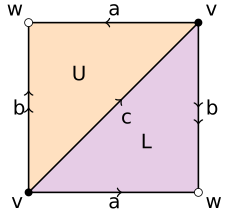
Take R = Z R = \mathbb{Z} R = Z R P 2 \mathbb{R}P^2 R P 2 Δ \Delta Δ Definition Delta complex 2026-10-04 · Lîm Tsú-thuàn v , w v, w v , w a , b , c a, b, c a , b , c U , L U, L U , L
Order the vertices of each triangle [ v 0 , v 1 , v 2 ] [v_0, v_1, v_2] [ v 0 , v 1 , v 2 ] v 0 v 1 = c v_0 v_1 = c v 0 v 1 = c v 1 v 2 = a , v 0 v 2 = b v_1 v_2 = a, v_0 v_2 = b v 1 v 2 = a , v 0 v 2 = b U U U v 1 v 2 = b , v 0 v 2 = a v_1 v_2 = b, v_0 v_2 = a v 1 v 2 = b , v 0 v 2 = a L L L
∂ 2 U = a − b + c ∂ 2 L = − a + b + c \partial_2 U = a - b + c
\qquad
\partial_2 L = -a + b + c ∂ 2 U = a − b + c ∂ 2 L = − a + b + c In the bases U , L U, L U , L a , b , c a, b, c a , b , c ∂ 2 \partial_2 ∂ 2
( 1 − 1 − 1 1 1 1 ) → R 2 + R 1 , R 3 − R 1 ( 1 − 1 0 0 0 2 ) → C 2 + C 1 , R 2 ↔ R 3 ( 1 0 0 2 0 0 ) \begin{pmatrix} 1 & -1 \\ -1 & 1 \\ 1 & 1 \end{pmatrix}
\xrightarrow{R_2 + R_1,\ R_3 - R_1}
\begin{pmatrix} 1 & -1 \\ 0 & 0 \\ 0 & 2 \end{pmatrix}
\xrightarrow{C_2 + C_1,\ R_2 \leftrightarrow R_3}
\begin{pmatrix} 1 & 0 \\ 0 & 2 \\ 0 & 0 \end{pmatrix} 1 − 1 1 − 1 1 1 R 2 + R 1 , R 3 − R 1 1 0 0 − 1 0 2 C 2 + C 1 , R 2 ↔ R 3 1 0 0 0 2 0 so the invariant factors are a 1 = 1 , a 2 = 2 a_1 = 1, a_2 = 2 a 1 = 1 , a 2 = 2 n = 2 n = 2 n = 2 b b b ∂ 1 a = ∂ 1 b = w − v \partial_1 a = \partial_1 b = w - v ∂ 1 a = ∂ 1 b = w − v ∂ 1 c = 0 \partial_1 c = 0 ∂ 1 c = 0 ∂ 1 \partial_1 ∂ 1 1 1 1
rank ker ∂ 1 = rank C 1 − rank ∂ 1 = 3 − 1 = 2 \text{rank} \ker \partial_1
= \text{rank}\ C_1 - \text{rank}\ \partial_1 = 3 - 1 = 2 rank ker ∂ 1 = rank C 1 − rank ∂ 1 = 3 − 1 = 2 Hence, b = 2 − 2 = 0 b = 2 - 2 = 0 b = 2 − 2 = 0
H 1 ( R P 2 ) ≅ Z 2 − 2 ⊕ Z / ( 1 ) ⊕ Z / ( 2 ) ≅ Z / 2 H_1(\mathbb{R}P^2) \cong \mathbb{Z}^{2-2} \oplus \mathbb{Z}/(1) \oplus \mathbb{Z}/(2)
\cong \mathbb{Z}/2 H 1 ( R P 2 ) ≅ Z 2 − 2 ⊕ Z / ( 1 ) ⊕ Z / ( 2 ) ≅ Z /2