Definition. The category of assemblies over a pca [math-I7R9]

Categorical Realizability

First, we define map between assemblies.

Definition assembly map [local-0]

An assembly map from an assembly XX to an assembly YY is a function f:∣X∣→∣Y∣f : |X| \to |Y| that is tracked by some element.

Definition Track [math-GM4F]

For assemblies XX and YY, we say that an element t∈At \in \mathcal{A} tracks a function f:∣X∣→∣Y∣f : |X| \to |Y| if for all x∈∣X∣x \in |X| and a∈Aa \in \mathcal{A}, if a⊩Xxa \Vdash_X x, then t at\ a is defined and t a⊩Yf(x)t\ a \Vdash_Y f(x).

Then, we check assemblies and assembly maps form a category.

Proposition assemblies and assembly maps form a category [local-2]

Proof [local-1]

If f:X→Yf : X \to Y and g:Y→Zg : Y \to Z are assembly maps, then g∘f:∣X∣→∣Z∣g \circ f : |X| \to |Z| is tracked. Let tft_f and tgt_g track ff and gg respectively. We claim that ⟨x⟩. tg(tf(x))\langle x \rangle.\ t_g(t_f(x)) tracks g∘fg \circ f, the closed term ⟨x⟩. tg(tf(x))\langle x \rangle.\ t_g(t_f(x)) is defined by construction, and if a⊩Xxa \Vdash_X x then

(⟨x⟩. tg(tf(x))) a=tg(tf(a))⊩Zg(f(x))(\langle x \rangle.\ t_g(t_f(x)))\ a = t_g(t_f(a)) \Vdash_Z g(f(x))

by choice of tft_f and tgt_g. Then we need identity, for each assembly XX, II tracks any identity on ∣X∣|X|, so assemblies and assembly maps form a category.

Notation AsmA\text{Asm}_{\mathcal{A}} [local-3]

We denote AsmA\text{Asm}_{\mathcal{A}} for the category of assemblies over a pca A\mathcal{A}.

Example [local-4]

The trivial pca has Asm{⋆}=Set\text{Asm}_{\{ \star \}} = \text{Set}.

Proposition terminal object [local-5]

The terminal object 11 in AsmA\text{Asm}_{\mathcal{A}} is given by

∣1∣≐{⋆}anda⊩1⋆ for all a∈A|1| \doteq \{ \star \} \quad\text{and}\quad a\Vdash_1 \star\ \text{for all}\ a \in \mathcal{A}

Proposition products [local-6]

The product X×YX \times Y of two assemblies is given by

∣X×Y∣≐∣X∣×∣Y∣andpair a b⊩X×Y(x,y) for all a⊩Xx and b⊩Yy|X \times Y| \doteq |X| \times |Y| \quad\text{and}\quad \bold{pair}\ a\ b \Vdash_{X \times Y} (x, y) \ \text{for all}\ a \Vdash_X x \ \text{and}\ b \Vdash_Y y

Proposition exponentials [local-8]

The exponential YXY^X of two assemblies is given by

∣YX∣≐the set of assembly maps from X to Yandt⊩YXf if t tracks f|Y^X| \doteq \text{the set of assembly maps from}\ X\ \text{to}\ Y \quad\text{and}\quad t \Vdash_{Y^X} f\ \text{if}\ t\ \text{tracks}\ f

Proof [local-7]

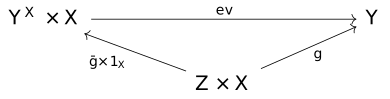
The evaluation morphism ev:YX×X→Yev : Y^X \times X \to Y is given by (f,x)↦f(x)(f,x) \mapsto f(x) is tracked by ⟨x⟩. fst u(snd u)\langle x \rangle.\ \bold{fst}\ u(\bold{snd}\ u). Every g:Z×X→Yg : Z \times X \to Y induces a unique assembly map gˉ:Z→YX\bar{g} : Z \to Y^X making the commute diagram:

figure tex16543

Since there is a unique assignment gˉ(z)≐(x↦g(z,x))\bar{g}(z) \doteq (x \mapsto g(z, x)) and the assignment is tracked by ⟨u⟩. (⟨v⟩. tg(pair u v))\langle u \rangle.\ (\langle v \rangle.\ t_g(\bold{pair}\ u\ v)) when tgt_g tracks gg.

Proposition equalizers [local-9]

The equalizer EE of two assembly maps f,g:X→Yf,g : X \to Y is given by

∣E∣≐{x∈∣X∣∣f(x)=g(x)}anda⊩Ex if a⊩Xx|E| \doteq \{ x \in |X| \mid f(x) = g(x) \} \quad\text{and}\quad a \Vdash_E x\ \text{if}\ a \Vdash_X x

Proposition initial object [local-10]

The initial object 00 is given by ∣0∣≐∅|0| \doteq \varnothing with empty realizability relation (no element so empty realizability is fine).

Proposition coproducts [local-11]

The coproduct X+YX + Y is defined by

∣X+Y∣≐∣X∣+∣Y∣andleft a⊩X+Yinl(x) for a⊩Xxright b⊩X+Yinr(y) for b⊩Yy\begin{aligned} |X + Y| \doteq |X| + |Y| \quad\text{and}\quad \bold{left}\ &a \Vdash_{X+Y} \text{inl}(x)\ \text{for}\ a \Vdash_X x \\ \bold{right}\ &b \Vdash_{X+Y} \text{inr}(y)\ \text{for}\ b \Vdash_Y y \end{aligned}

where

left≐pair false and right≐pair true\bold{left} \doteq \bold{pair}\ \bold{false} \ \text{and}\ \bold{right} \doteq \bold{pair}\ \bold{true}

Proposition coequalizers [local-12]

The coequalizer CC of assembly maps f,g:X→Yf,g : X \to Y is given by

∣C∣≐∣Y∣/∼anda⊩C[y] if a⊩Yy′ for some y′∼y|C| \doteq |Y|/\sim \quad\text{and}\quad a \Vdash_C [y] \ \text{if}\ a \Vdash_Y y' \ \text{for some}\ y' \sim y

where ∼\sim is the least equivalence relation on ∣Y∣|Y| generated by f(x)∼g(x)f(x) \sim g(x) for all x∈∣X∣x \in |X|.