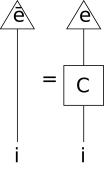
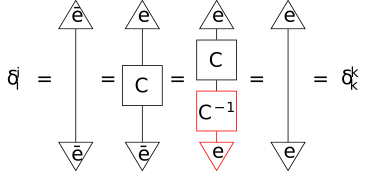
Manifolds and Differential Geometry Let e1,e2,…,en∈Ve_1, e_2, \dots, e_n \in Ve1,e2,…,en∈V be a basis of vector space VVV, and let e1,…,en∈V∗e^1, \dots, e^n \in V^*e1,…,en∈V∗ be a basis of dual space V∗V^*V∗. Now if eˉi=C ikek\bar{e}_i = C^k_{\ \ i} e_keˉi=C ikek is another basis of VVV, then there is an induced basis eˉi=(C−1) kiek\bar{e}^i = (C^{-1})^i_{\ \ k} e^keˉi=(C−1) kiek for dual space V∗V^*V∗. Proof [local-0] By Kronecker-delta 1=δ ii1 = \delta^i_{\ i}1=δ ii 1=δ ii=eˉieˉi=C ikekeˉi1 = \delta^{i}_{\ i} = \bar{e}_{i} \bar{e}^{i} = C^k_{\ \ i} e_{k} \bar{e}^{i}1=δ ii=eˉieˉi=C ikekeˉi can see that if eˉi=ek(C−1)ki\bar{e}^{i} = e^{k} (C^{-1})^i_keˉi=ek(C−1)ki then the equality is hold. We can use Penrose notation to show the idea.
By Kronecker-delta 1=δ ii1 = \delta^i_{\ i}1=δ ii 1=δ ii=eˉieˉi=C ikekeˉi1 = \delta^{i}_{\ i} = \bar{e}_{i} \bar{e}^{i} = C^k_{\ \ i} e_{k} \bar{e}^{i}1=δ ii=eˉieˉi=C ikekeˉi can see that if eˉi=ek(C−1)ki\bar{e}^{i} = e^{k} (C^{-1})^i_keˉi=ek(C−1)ki then the equality is hold. We can use Penrose notation to show the idea.